



The Asia Pacific (APAC) protein market is shifting gears quietly but rapidly. For a long time, protein was mainly linked to plant-based innovation and sports nutrition. But that is no longer driving APAC’s narrative. In this blog, we look across APAC big food categories to see where demand is building, where innovation is still limited, and where brands may have room to enter with products that feel useful, familiar, and easy to adopt.
Key Takeaways for High Protein Innovation in APAC
- The best entry opportunities in the APAC protein market are likely found in categories where growth is high, consumer demand is ahead of supply, and competition remains limited.
- Bakery, ready meals, and selected snacks and beverage formats stand out as the easiest opportunities for manufacturers seeking early-mover advantage.
- From a segmentation standpoint, sports nutrition remains a high-potential commercial opportunity, supported by strong repeat purchase behavior patterns from consumers. However, the category itself needs to be redefined as it moves beyond bars, RTD’s, powders etc.
Jump to each section
- How Are APAC Consumers Driving High Protein Demand?
- What Is Driving High Protein Innovation in Asia Pacific?
- Which High Protein Categories Are Growing Fastest in APAC?
- What Is the Leading Tier in APAC High Protein?
- What Is the Growing Tier and Why It Matters Most for First Movers?
- What Is the Emerging Tier in APAC High Protein?
- Which High Protein Categories Are Slowing in APAC?
- Where Should Food Manufacturers Focus High Protein Innovation Next?
How Are Asia Pacific Consumers Driving High Protein Demand?
Since COVID, consumers have started thinking differently about food and health. Gen Z is entering the market with new innovative flavor demands, while millennials and Gen X are becoming more informed about nutrition and long-term wellbeing. Protein is now speaking to a much wider group of everyday consumers. They are not only looking for protein to train harder. They are looking for energy, fullness, muscle health, and meals that feel more complete.
At the same time, sports nutrition consumers want protein in every meal, and GLP-1 adoption is driving attention to satiety, nutrient density, and muscle maintenance. This opens the door for high protein to move beyond bars, shakes, and gym-focused formats, encouraging repeat purchase across everyday categories.
So the question for manufacturers is simple: “In which category does protein make sense next?”

What Is Driving High Protein Innovation in Asia Pacific?
APAC High Protein Market Reaches USD 10.1 Billion in 2025
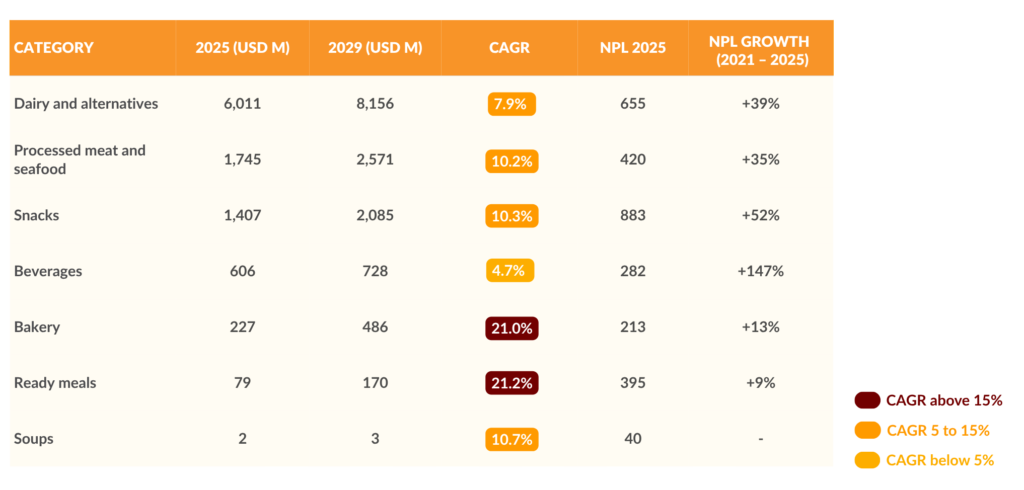
For this analysis, we drew on Euromonitor data to review seven major food categories across APAC to identify where protein penetration is highest. The table below shows how each category compares in terms of market size, growth, and how launch numbers have changed over the past five years.
Overall, the high protein market reached USD 10.1B in retail value in 2025 and is projected to add more than USD 4B in new retail value by 2029. This amounts to approximately USD 1B in net new high protein retail value created across the region each year.¹
How Fast Is High Protein Product Launch Activity Growing in APAC?
In terms of new product launch activity, the broader market grew by 47%.² Within the seven categories we studied, high protein product launches increased by 39%² over the past five years, though the growth rate varied significantly by category.
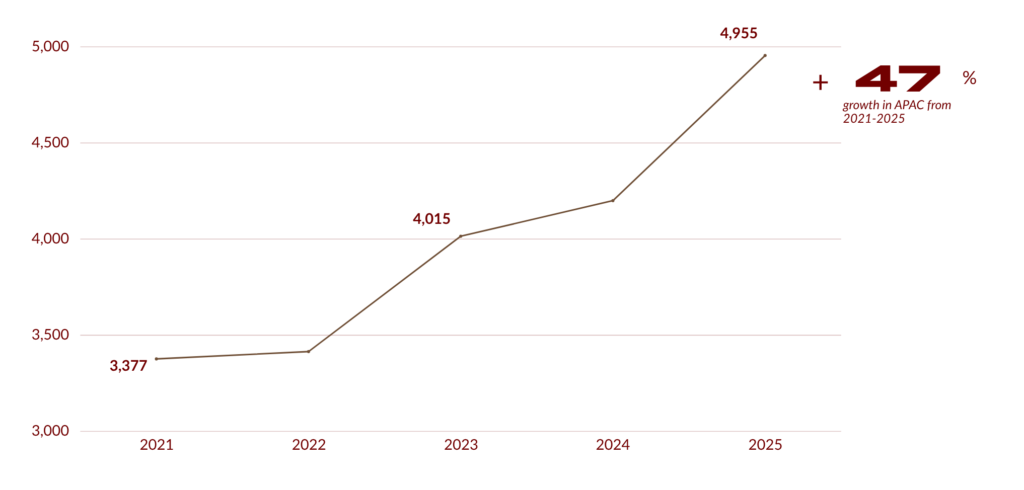
This shows that innovation is not happening at the same rate across all high protein categories.
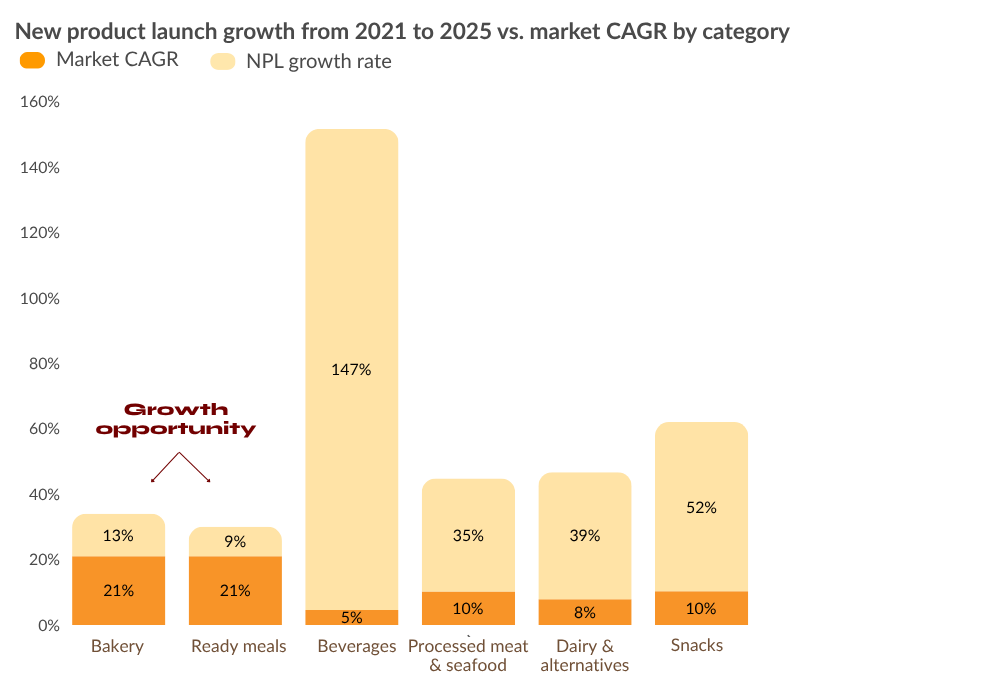
Some of the fastest-growing categories are still attracting few new products, creating a clear gap between market demand and launch activity. This gap points to one of the most significant commercial opportunities in the region.
Which High Protein Categories Are Growing Fastest in APAC?
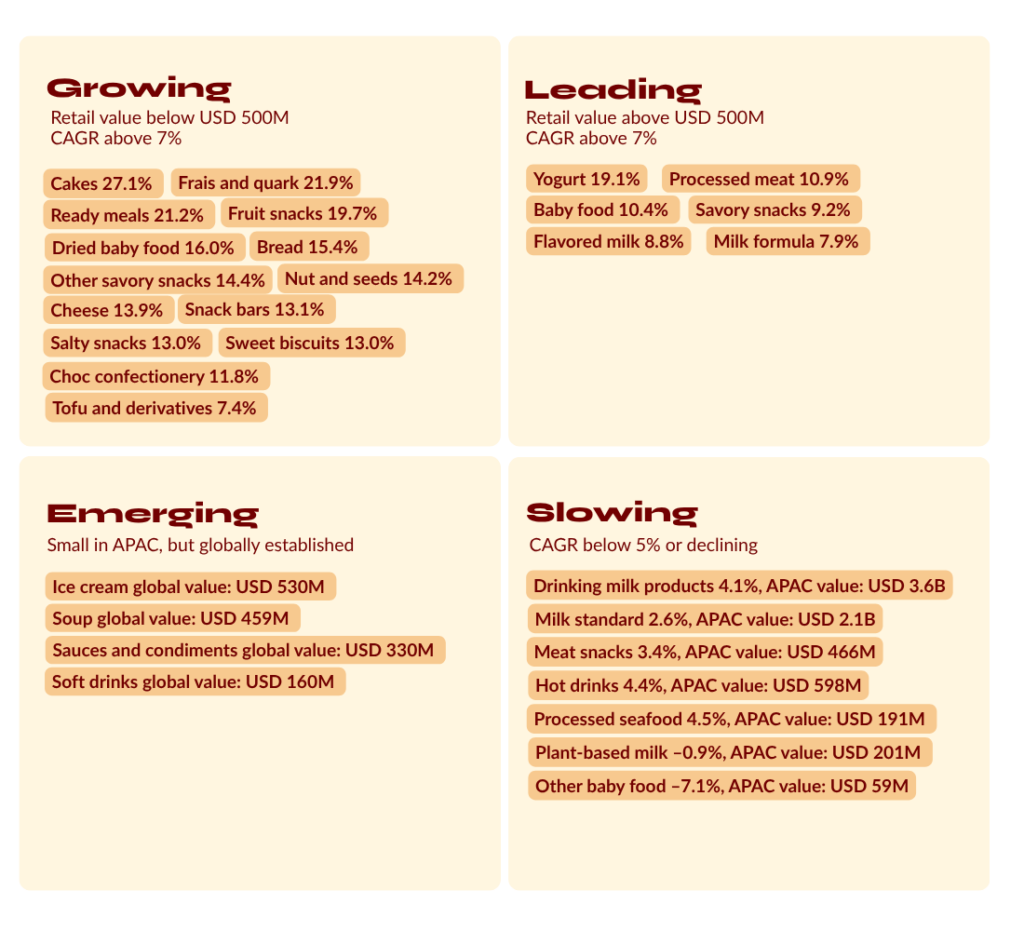
Not all high protein categories in APAC are developing at the same pace. Some are already large and competitive, while others are smaller but growing quickly. To compare opportunities, we sort APAC’s high protein categories into four tiers, each signaling a different strategic play. Together, these help show which categories are already well established, which ones are gaining traction, and where new opportunities may be opening up.
How to read the matrix
The leading tier includes categories that are both large and fast-growing, with retail value above USD 500M and a CAGR above 7%. These categories already have proven demand, but they are also likely to be more competitive.
The growing tier includes categories that are growing quickly but are still relatively small, with retail value below USD 500M and a CAGR above 7%. These categories may offer the most attractive entry opportunities, because demand is rising but the market is not yet crowded.
The emerging tier includes categories that have shown growth globally, but are still at an early stage in APAC. These segments are less developed, which means the competitive landscape is still relatively open.
The slowing tier includes categories with a CAGR below 5%, where growth is starting to cool. These may be less attractive for new market entry, but they can still be important for established players looking to protect their current position.
What Is the Leading Tier in APAC High Protein?
Categories above USD 500M in retail value and above 7% CAGR
These are crowded categories where many brands are already competing for share. The opportunity is attractive because demand is proven, but success depends on differentiation rather than simply entering the space. Winning here is less about being first and more about executing better, with sharper positioning, stronger credentials and faster innovation cycles.
| Sub-segment | 2025 (USD M) | 2029 (USD M) | CAGR | Key takeaway |
|---|---|---|---|---|
| HP yoghurt | 557 | 1,122 | 19.1% | Doubling by 2029. Strong market players in this segment. |
| HP processed meat | 1,476 | 2,236 | 10.9% | Largest absolute value added. USD 760M by 2029. Demand will continue to grow. |
| HP baby food | 1,437 | 2,134 | 10.4% | Stable large base. USD 697M added. Interesting category to innovate with different protein profiles. |
| HP savory snacks | 996 | 1,414 | 9.2% | Largest snack sub-segment in APAC, offering a strong platform to test limited-time offers and drive innovation. |
| HP flavored milk drinks | 656 | 921 | 8.8% | Steady year-over-year growth, adding approx. USD 265M by 2029. |
| HP milk formula | 882 | 1,194 | 7.9% | Contributing over half of baby food category value. |
What Is the Growing Tier and Why It Matters Most for First Movers?
Categories below USD 500M in retail value and above 7% CAGR
This tier represents the clearest first-mover opportunity in the APAC protein market. Consumer demand is already running ahead of product supply. Manufacturers have not yet moved in at scale, which means early entrants can establish positions before the competitive field fills in.
| Sub-segment | 2025 (USD M) | 2029 (USD M) | CAGR | Key insight |
|---|---|---|---|---|
| HP cakes | 116 | 303 | 27.1% | Fastest-growing sub-segment. Adding USD 187M by 2029. |
| HP fromage frais and quark | 36 | 79 | 21.9% | Highest dairy sub-segment CAGR. No dominant APAC player. |
| HP ready meals | 79 | 170 | 21.2% | More than doubles by 2029. |
| HP fruit snacks | 31 | 64 | 19.7% | Doubles by 2029. |
| HP dried baby food | 489 | 887 | 16.0% | Fast-growing sub-segment within baby food. |
| HP bread | 102 | 181 | 15.4% | Strong growth within HP bakery segment. |
| HP cheese | 311 | 524 | 13.9% | Strong growth. No dominant APAC player. |
| HP snack bars | 108 | 177 | 13.1% | 2.1x faster than total snack bars at 6.1% CAGR. |
| HP salty snacks | 129 | 210 | 13.0% | Adding USD 81M by 2029. Growing well ahead of the global rate. |
| HP sweet biscuits | 190 | 310 | 13.0% | Adding USD 120M by 2029. |
Why High Protein Bakery and Ready Meals Are the Biggest Opportunities
Bakery and ready meals are two of the fastest-growing high protein categories in APAC, with both growing at around 21% CAGR.² At the same time, new product launches are growing much more slowly compared to other categories, at 13% for bakery and 9% for ready meals.² In simple terms, consumers are showing interest, but brands are not launching enough new options yet. For bakery, this could mean more room for high protein bread, cakes, biscuits, and other baked goods.
Taking sweet baked goods as an example, consumers who are eating more say this is driven by greater variety, stronger interest in the category, and healthier options.³
This suggests that innovation can help move bakery from an occasional treat to a more regular, better-for-you snack.
The challenge for brands is to balance protein content, taste profile, and health claims within a single formulation. This is where yeast protein expertise becomes valuable, especially in bakery where yeast is already a trusted ingredient.
For ready meals, the same logic applies. Innova highlights that busy schedules and urban lifestyles are increasing demand for convenient meal options in Asia, while taste, convenience, and protein remain important product claims.⁴
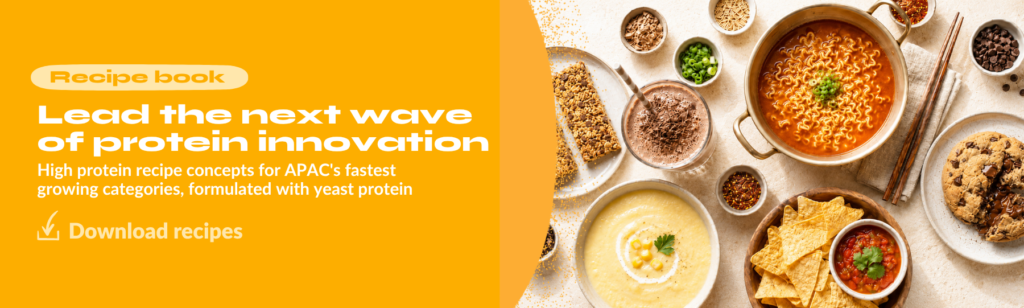
This creates space for more high protein ready meals that fit naturally into everyday routines. Picture instant noodles fuelling a night shift, a soup packet supporting an elderly consumer’s protein intake, or a meal kit powering the gym crowd’s lunch break.
What’s Trending in Protein Snacks? Growth Is Uneven. The Opportunity Is Not Just in Energy Bars
Snack growth is uneven, and the format opportunity is far wider than energy bars alone. For manufacturers, the opportunity is not simply to enter snacks broadly, but to choose the right snack spaces and understand how to stand out within them.
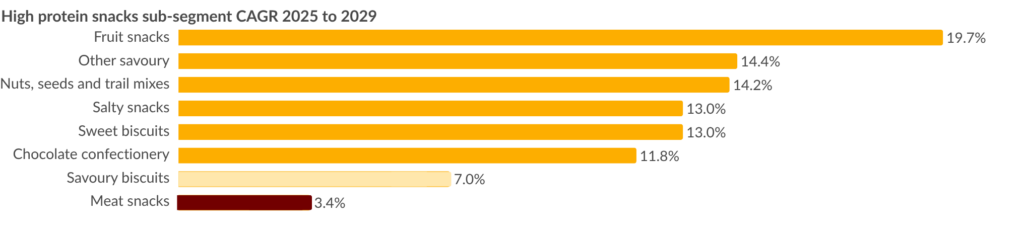
Bars themselves are splintering into endless variations from cookie-dough, brownie, breakfast, indulgent. Protein gummies are rising fast as a low-friction crossover with supplements. Savory snacks are layering bold fusion seasonings like Korean BBQ, kimchi, masala, tom yum, spicy mayo onto chip and cracker bases. And the list keeps growing.
To win across these formats, brands need a protein with neutral taste, dry-application stability, and a clean label, not just a high gram count. In our recipe sheet, we share practical ways to innovate in these high-potential snack formats and build stronger protein-led concepts for the snack aisle
What Is the Emerging Tier in APAC High Protein?
Categories have been proven globally but not yet built in APAC
To identify future opportunities, we also looked at high protein categories that are already growing globally but are not yet established at scale in APAC.⁵
These categories are starting to appear on APAC shelves, but the market is still in its early stages. This lowers the risk for manufacturers because the demand model has already been proven in other regions. For brands, this creates an opportunity to innovate early, adapt successful global formats to local APAC preferences, and build a position before the category becomes more competitive.
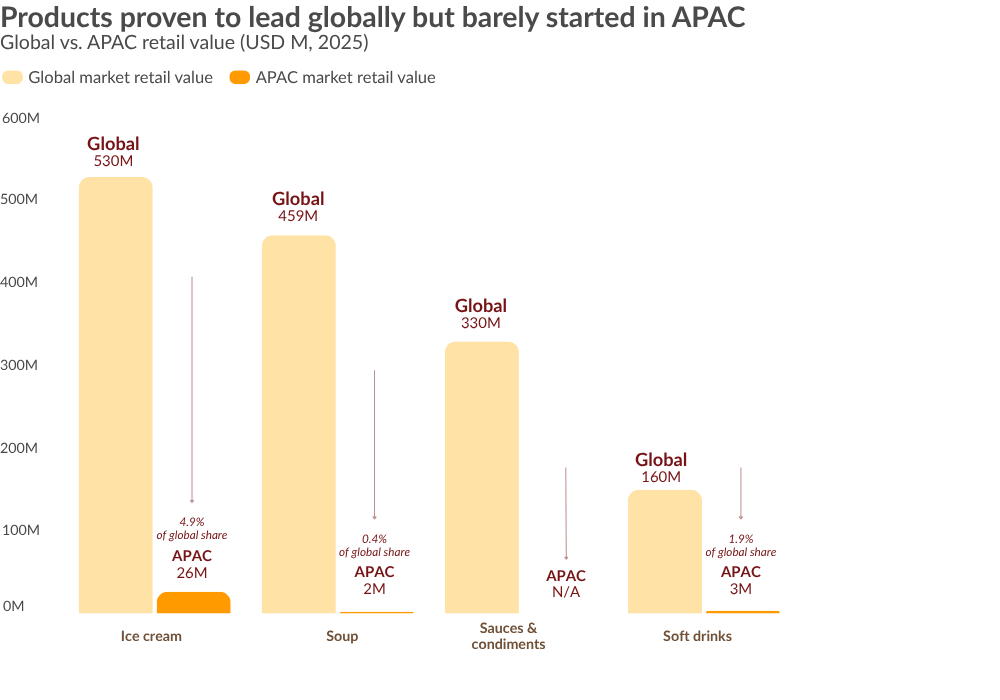
Soup is APAC’s quietest high protein opportunity. The region consumes USD 3.1 billion of soup a year, yet high protein soup is under 0.1% of that. Globally the segment is already at USD 459 million and growing 10.7%. Soup runs deep in APAC’s food culture. What it lacks is the high protein development.
At the same time, these categories are not easy to execute. Technical challenges such as protein stability in frozen formats, flavor neutrality in clear beverages, heat stability in liquid applications, and clean taste in condiment bases have slowed development so far.
But these barriers are also what limit competition. Manufacturers that solve them first will be better positioned to lead as these categories grow.
Download our formulation guide to see how Springer Proteissimo® supports development across each of these formats.
Which High Protein Categories Are Slowing in APAC?
Categories with CAGR below 5% or declining
Based on our recommendations, these are not areas to lead with new investment. For manufacturers already active in these segments, the strategic priority is defending existing positions and protecting margins rather than committing capital to build new ones.
| Sub-segment | 2025 (USD M) | 2029 (USD M) | CAGR | Key takeaway |
|---|---|---|---|---|
| HP drinking milk products | 3,640 | 4,274 | 4.1% | Massive value but highly saturated. |
| HP milk (standard) | 2,137 | 2,365 | 2.6% | Large but slow. Declining as a proportion of the total market. |
| HP meat snacks | 466 | 532 | 3.4% | Mature and competitive. |
| HP hot drinks | 598 | 711 | 4.4% | Steady but not accelerating. |
| HP processed seafood | 191 | 227 | 4.5% | Low growth relative to broader market momentum. |
| HP plant-based milk | 201 | 193 | -0.9% | Declining retail value. Only major sub-segment contracting. |
| HP other baby food | 59 | 44 | -7.1% | Declining. Losing share within the baby food category. |
Where Should Food Manufacturers Focus High Protein Innovation Next?
The next phase of protein growth in APAC will not come from entering every category. It will come from choosing the right ones. And yes, we know that the opportunity is not just about adding protein. It is about making high protein products that taste good, fit everyday eating habits, and work technically across different formats.
That is where formulation expertise matters. Our application centre has designed a recipe book called “The Next Wave of Protein Innovation.”
It offers ready-to-formulate concepts for the fastest growing high protein categories, developed with Biospringer’s new yeast protein Springer Proteissimo® 102 to support protein enrichment.
Springer Proteissimo® 102 supports hybrid blends and whey reduction, delivering all nine essential amino acids with clean label credentials and high digestibility.
Download The Next Wave of Protein Innovation to turn these opportunities into market-ready products.
Sources and notes
¹ Euromonitor International Passport, high protein launches in Asia-Pacific, 2026.
² Innova Market Insights Database, high protein claim launches in Asia-Pacific, 2026.
³ Innova Market Insights, Cookies & Sweet Baked Goods in Asia Pacific, 2026.
⁴ Innova Market Insights, Ready Meals Around the Globe: Serving Up Fresh & Flavorful Convenience, 2025.
⁵ Euromonitor International Passport, global high protein packaged food retail value data, 2026.
Note: “High protein” refers to products positioned as having relatively high levels of protein. This includes claims such as “filled with protein,” “loaded with protein,” “rich in protein,” “protein boost,” or “with added protein.”